
Choosing the right noise management for each listener
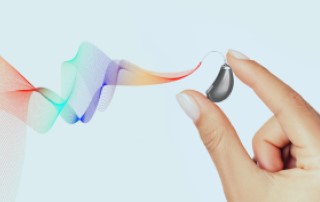
Hearing aid options to improve communication in noise include directional processing, digital noise suppression, and remote microphones. We examined the relationship between speech in noise difficulties and the technology the patient received in their clinical fitting.
Beam me (in)
Hearing aid beamformers are intended to emphasize the talker’s voice and reduce surrounding noise. But are beamformers right for everyone? In new data presented at the 2022 International Hearing Aid Conference, we examined the benefit of a beamformer in which the optimal polar plot was selected by analysis of signal inputs across both ears (sometimes called “ear to ear” directionality).
Over-the-counter hearing aids are here!
On August 16, 2022, the U.S. Food and Drug Administration issued their final rule for over-the-counter hearing aids. What does this mean for listeners with hearing loss? Over-the-counter (OTC) hearing aids are approved for adults with mild or moderate hearing loss, and can be purchased by consumers without seeing an audiologist or physician.
Mind the gaps: filling in missed speech information
During conversations in noise, we don’t hear every word or sound. Top-down perceptual restoration allows us to fill in missed information, but what abilities make this process easier for some people than others?
The “grandparent study”
Older adults with hearing loss often report they have difficulty understanding their young grandchildren, even when wearing hearing aids that improve audibility. We collaborated with Dr. Marisha Speights Atkins to examine perception of child talkers by older adults, using child speech from the Speech Exemplars and Evaluation Database (SEED).
Guidelines for fitting severe hearing loss
Any hearing loss can affect communication, but listeners with severe loss face the greatest challenges. For those listeners, speech is less audible, more distorted, and more susceptible to background noise. How should we address the needs of listeners with severe and profound loss?
Hearing aids for adults with mild cognitive impairment or early Alzheimer’s Dementia
Difficulties associated with spoken conversation are a primary impairment for adults with mild cognitive impairment or dementia, but most studies on communication affected by Alzheimer’s dementia did not consider – or treat--the additive impact of hearing loss.
When and how to screen for changes in cognition
Providers within and outside audiology have asserted that screening and awareness of cognitive decline should be part of treatment decisions. We were interested to know how and when audiologists screened for cognitive change.
Using a remote microphone to improve communication in noise
Listening can be difficult—and hearing aids alone may not be sufficient to improve communication--when the speaker is at a distance, in a noisy environment, or in a reverberant space. In a recent study, adult participants with sensorineural hearing loss were provided with a remote microphone, the Roger Select, for a one-month trial.